
Freezer-side faults · Campbell, CA
Sub-Zero Freezer Repair in Campbell — Not Cold or Not Freezing
When a Sub-Zero freezer is not freezing or not cold enough, the freezer-side causes are usually a frost-blocked freezer evaporator, a defrost-circuit fault (heater, sensor or control), a stalled freezer evaporator fan, a worn drawer or door gasket, or — on dual-compressor classic units — an imbalance where the freezer compressor weakens while the fridge stays cold. We are Campbell-based Sub-Zero specialists: factory-spec diagnosis, genuine OEM parts, $89 service call waived with the repair, and a 365-day labor warranty.

Quick answers
Sub-Zero freezer not cold: fast answers
The exact freezer-side scenarios Campbell homeowners describe — and what each one usually means.
Freezer warm but the fridge is still cold?
On a built-in Sub-Zero the freezer and fridge run on separate refrigeration, so a warm freezer with a cold fridge is a freezer-side fault — most often a frosted freezer evaporator, a defrost failure on that circuit, a stalled freezer fan, or (on dual-compressor classics) a weak freezer compressor. It is not a whole-unit problem.
Freezer not freezing at all (ice cream is soft)?
A freezer that holds at, say, 20–25°F instead of 0°F is usually losing airflow to frost on the evaporator or a defrost-circuit fault, or has a freezer fan that is not spinning. Soft ice cream with hard frost on the back wall points squarely at the defrost system.
Heavy frost or ice packing the freezer?
Frost building on the freezer back panel or floor means the defrost cycle is not clearing it — a failed defrost heater, defrost sensor, or control — or humid air is leaking past a worn door/drawer gasket. The ice then blocks the freezer outlet and slowly warms the compartment.
Ice maker stopped because the freezer is warm?
A freezer that drifts above about 5°F often stops the ice maker before anything else. Fix the freezer temperature first; if the freezer holds 0°F and there is still no ice, see our ice maker page for module and fill-tube faults.
Just want the safe checks before calling?
Confirm the drawer/door seals and shuts flush, clear food off the freezer air vents, vacuum the condenser behind the grille, verify the set point near 0°F, then give it 24 hours. Full steps are below.
Why a Sub-Zero freezer fails on its own — the dual-refrigeration difference
The reason a Sub-Zero freezer can quit while the fridge stays perfect is the brand’s signature dual refrigeration: the freezer and the refrigerator each have their own evaporator, their own airflow path, and on the Classic BI columns their own compressor. A general appliance tech used to single-evaporator fridges often misreads this — they see a warm freezer and start chasing the whole sealed system, when the fridge side proves the unit, the condenser, and half the controls are fine. The fault is isolated to the freezer circuit.
That distinction changes the whole diagnosis. A warm fridge with a cold freezer points to the fridge evaporator fan or a blocked air duct between compartments. A warm freezer with a cold fridge points the other way — to the freezer evaporator, the freezer defrost components, the freezer fan, or, on the dual-compressor classics, a freezer compressor or its start components weakening while the fridge compressor runs on happily.
Campbell gives us both fleets. The long-tenured kitchens around San Tomas and the Cambrian-adjacent streets run Classic BI 600/700-series columns and over-and-unders with two compressors, where defrost-circuit and freezer-compressor faults are common after fifteen-plus years. The remodels near the Pruneyard and Downtown Campbell lean toward newer integrated freezer columns and drawers, where a frosted evaporator or a sensor fault is the more typical cause. Either way, we isolate the freezer circuit before touching anything shared.
Fridge-side vs freezer-side: telling them apart
The single fastest way to narrow a Sub-Zero fault is to compare what each compartment is doing. Match your pattern below.
| What you observe | Which side is failing | Most likely cause |
|---|---|---|
| Freezer warm, fridge still cold | Freezer circuit | Frosted freezer evaporator, defrost fault, stalled freezer fan, or (classic) weak freezer compressor |
| Fridge warm, freezer still cold | Fridge circuit | Stalled fridge evaporator fan, frosted fridge coil, or blocked air duct between compartments |
| Both warm, unit runs constantly | Shared / whole unit | Dirty or blocked condenser, failed condenser fan, or sealed-system fault — clean the condenser first |
| Freezer freezes, ice cream still soft | Freezer circuit | Freezer holding 10–20°F: partial frost block, marginal fan, or defrost cycle running short |
| Heavy frost packing the freezer | Freezer defrost | Failed defrost heater, defrost sensor, or control; or humid air past a worn drawer/door gasket |
| Freezer warm and ice maker stopped | Freezer circuit | Freezer above ~5°F halts the ice maker — fix freezer temp before the ice maker itself |
A frost-blocked freezer evaporator mimics a dead compressor from the kitchen. Confirming the defrost circuit and airflow before condemning the sealed system is what keeps a Sub-Zero freezer repair from being paid for twice.
The freezer-side faults we diagnose most in Campbell
These are the specific freezer-circuit failures behind most "Sub-Zero freezer not cold" calls — each one is isolated and tested before any part is replaced.
Frost-blocked freezer evaporator
Frost packs the freezer coil and the air outlet behind the rear panel, choking cold airflow. The freezer warms even though the compressor runs. Almost always a downstream symptom of a defrost-circuit fault rather than the root cause.
Defrost-circuit failure
The defrost heater, defrost thermostat/sensor, or control that should melt frost on a timed cycle has failed. Frost accumulates until it blocks the evaporator. This is the most common reason a Sub-Zero freezer slowly stops freezing.
Stalled freezer evaporator fan
The fan that pushes cold air off the freezer coil into the compartment seizes or fails. The coil still gets cold but the air does not move, so the freezer warms while frost builds locally on the coil.
Dual-compressor imbalance (Classic BI)
On Classic 600/700-series columns the freezer has its own compressor. When that compressor, its start relay or capacitor weakens, the freezer drifts warm while the fridge compressor keeps the fresh-food side perfectly cold — a fault unique to dual-refrigeration units.
Worn drawer or door gasket
A hardened or torn freezer gasket lets warm, humid Santa Clara Valley air leak in around the clock. That moisture feeds frost on the evaporator and forces the freezer to run long and warm. Common on heavily used freezer drawers.
Sensor or control fault
A failed freezer thermistor or a control misreading freezer temperature can run the cycle wrong — short-cycling the defrost, never calling for cooling, or reporting the wrong temperature. Newer integrated columns lean toward this over mechanical wear.
Do not keep opening the freezer to check on it — every opening dumps warm, humid air in and feeds more frost. Do not chip or hack at ice on the evaporator panel; you can puncture a coil or the defrost heater and turn a sensor job into a sealed-system job. And do not repeatedly unplug to "reset" a dual-compressor classic — on a freezer-compressor or defrost fault that only hides the symptom while your food keeps thawing. Move food to a backup freezer and book the diagnosis.
Homeowner checks before you call
Six safe checks that resolve a fair share of "Sub-Zero freezer not freezing" calls in Campbell. If the freezer is still warm after 24 hours, the defrost circuit, fan, sensor or compressor needs hands-on testing.
- 1Confirm the drawer or door seals and shuts flush
Close the freezer on a slip of paper and tug — if it slides out freely the gasket is not sealing. Wipe the gasket, check for tears or a permanent set, and make sure no food or basket is holding the drawer open even a fraction.
- 2Clear the freezer air vents
Move packed food away from the rear and side air outlets inside the freezer and off the floor vents. Sub-Zeros freeze by moving air across the coil — a box jammed against the outlet can warm the compartment even when everything else is working.
- 3Vacuum the condenser
Power down, pull the grille (upper or lower depending on model), and vacuum and brush the condenser coil and fan. A clogged condenser makes both circuits struggle; clearing it sometimes lets a marginal freezer recover on its own.
- 4Verify the freezer set point
Confirm the freezer is set near 0°F and that no display mode — Sabbath, showroom or service mode — has been triggered by accident. Reset to factory set points if anything looks off.
- 5Look (and listen) for frost and the fan
A solid sheet of frost on the freezer back panel points to the defrost circuit; a quiet freezer with no airflow points to the fan. Note what you see — it speeds the diagnosis and the right part on the van.
- 6Give it 24 hours, then book a specialist
After sealing the door, clearing vents and cleaning the condenser, let it run a day with minimal openings. A healthy Sub-Zero freezer returns to 0°F within 24 hours. If it stays warm, the freezer circuit needs gauges and meters, not guessing.
When the defrost circuit is the real culprit
The most common reason a Sub-Zero freezer slowly stops freezing is a defrost-circuit fault. Every Sub-Zero freezer frosts its evaporator a little as it runs; a timed defrost cycle is supposed to melt that frost away. When the defrost heater, defrost sensor, or control fails, the frost never clears — it grows until it packs the coil and blocks the air outlet, and the freezer warms even though the compressor is still pumping.
This is exactly the fault that gets misdiagnosed as a dead compressor or "low Freon." The compressor is fine; the airflow is buried in ice. We confirm it by reading the freezer evaporator, testing the heater and sensor, and verifying the control’s defrost timing — then fitting genuine OEM Sub-Zero defrost components sized to your exact model so the cycle clears frost the way it was engineered to.
If frost keeps coming back after a fix, the door or drawer gasket is often letting humid air in, and a warm freezer is also the first thing to stop the ice maker. Every freezer repair we complete carries a 365-day labor warranty.
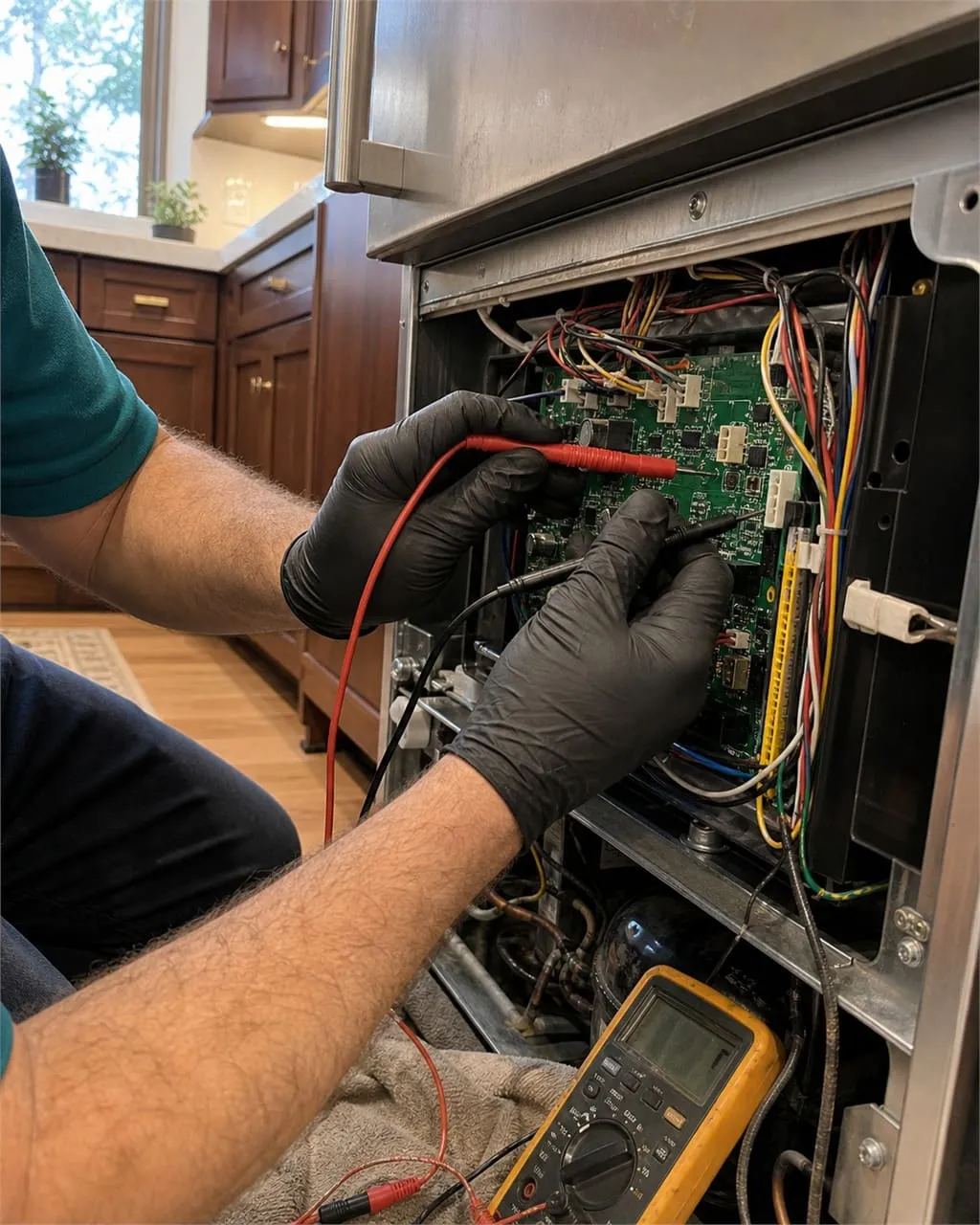
Typical Sub-Zero freezer repair costs in Campbell
Planning ranges, not quotes. Defrost, fan and gasket fixes sit at the lower end; freezer-compressor and sealed-system work runs higher because it needs gauges, evacuation and recharge. The $89 service call is waived when you approve the repair.
| Service in Campbell | Planning range | Typical time | Notes |
|---|---|---|---|
| Service call / diagnostic | $89 (waived with repair) | 45–90 min | Model, temperatures, airflow, sealed-system & electrical checks |
| Ice maker / water line | $275–$850 | 1–3 hrs | Inlet valve, fill tube or ice-maker module |
| Door gasket / frost line | $400–$900 | 1–3 hrs | Depends on model and gasket availability |
| Control board / sensor | $350–$1,250 | 1–4 hrs | Quoted after electrical diagnosis |
| Compressor / sealed system | $1,450–$3,600 | 2–6 hrs + parts | Requires pressure & electrical evidence |
These are planning estimates, not quotes — final pricing depends on model, parts, access and on-site diagnosis. The $89 service call is waived when you approve the repair.
Repairing a freezer compressor on a Classic BI built-in
On the Classic BI 600/700-series columns common in older San Tomas and Cambrian-adjacent Campbell kitchens, the freezer has its own dedicated compressor. That design is the reason a freezer can fail in isolation — and it is also why a "warm freezer, cold fridge" complaint on these units sometimes points past the defrost circuit to the freezer compressor, its start relay, or its run capacitor. We test the electrical components first, because a tired relay or capacitor is a fraction of the cost of a compressor and produces the very same symptom.
When the freezer compressor itself has genuinely weakened or failed, the repair is more involved — recovery, replacement and a proper recharge of the freezer circuit — and it runs higher. On a built-in Sub-Zero it is usually still worth it: the cabinetry is custom, the fridge side typically has years of life left, and restoring the freezer circuit costs far less than replacing a five-figure integrated unit. We only recommend that work after pressure and electrical evidence confirms it, never on a guess.
Not sure whether your unit is a dual-compressor classic or a newer single-system column? Snap a photo of the model and serial tag (upper-left interior wall, behind the grille, or on a drawer housing) before you call, and we will confirm the layout and bring the right OEM parts. Compare ranges on our cost guide, or start with the broader not-cooling diagnosis if both sides feel off.
Reviews
Campbell freezer repairs, in their words
Independent Sub-Zero repair · Campbell & the Santa Clara Valley
Our Classic BI freezer column was warm and ice cream was turning to soup, but the fridge side stayed perfectly cold. They explained the dual-refrigeration design, found the defrost heater had failed, and fitted a genuine OEM part. Freezing again by evening and the $89 call was waived once we approved it.
Frost was packing the back of our integrated freezer column and the ice maker had quit. The tech traced it to a defrost sensor, not the compressor another company wanted to replace. Honest diagnosis, OEM sensor, and he pointed out the gasket was fine. The 365-day warranty sealed it for me.
Warm freezer, cold fridge on an older built-in. Turned out to be the freezer compressor start relay, not the compressor itself — a fraction of what I feared. They tested the electrical parts first and were straight with me about it. Holding 0°F since. Genuinely appreciated the honesty.
Freezer drawer would not get below the 20s. Stalled evaporator fan. Diagnosis was thorough and they used a genuine Sub-Zero fan, though it had to be ordered so it took a second visit. Fair price and the freezer has held perfectly since. Would call them again.
FAQ
Sub-Zero freezer repair FAQ — Campbell
Why is my Sub-Zero freezer not freezing but the fridge is still cold?
Built-in Sub-Zeros use dual refrigeration, so the freezer and refrigerator run on separate systems. A warm freezer with a cold fridge is a freezer-side fault — most often a frost-blocked freezer evaporator, a defrost-circuit failure, a stalled freezer fan, or, on Classic BI columns, a weakening freezer compressor. It is not a whole-unit problem, which is why isolating the freezer circuit matters.
My Sub-Zero freezer is not cold enough — ice cream is soft. What is wrong?
A freezer holding around 10–25°F instead of 0°F is usually losing cold airflow to frost on the evaporator, has a defrost cycle that is not clearing that frost, or has a freezer fan that is not spinning. Hard frost on the back wall with soft food points to the defrost circuit; quiet, still air points to the fan. Both are testable before any sealed-system work.
Why is heavy frost or ice building up in my Sub-Zero freezer?
Frost packing the freezer back panel or floor means the defrost cycle is not melting it away — a failed defrost heater, defrost sensor, or control — or humid air is leaking past a worn drawer or door gasket. The ice then blocks the freezer air outlet and warms the compartment. Chipping at it risks puncturing the coil; it needs a defrost-system test and, if torn, a new OEM gasket.
Can the freezer fail while the rest of the Sub-Zero works fine?
Yes, and on Sub-Zero it is common. Because the freezer and refrigerator have separate evaporators — and on Classic BI columns separate compressors — the freezer circuit can fail on its own while the fridge side stays perfectly cold. A general tech used to single-system fridges often misreads this and chases the whole sealed system; the fix is usually isolated to the freezer circuit.
What is a dual-compressor imbalance on a Sub-Zero?
On Classic BI 600/700-series units the freezer has its own dedicated compressor. When that compressor, its start relay or its run capacitor weakens, the freezer drifts warm while the fridge compressor keeps the fresh-food side cold — an imbalance unique to dual-refrigeration units. We test the relay and capacitor first because they cost far less than a compressor and cause the same symptom.
My freezer is warm and the ice maker stopped — are they related?
Usually yes. A freezer that drifts above about 5°F will stop the ice maker before you notice anything else, so the warm freezer is the root cause. Fix the freezer temperature first. If the freezer holds 0°F and there is still no ice, the fault is in the ice maker itself — fill tube, inlet valve or module — covered on our ice maker page.
How much does Sub-Zero freezer repair cost in Campbell?
Planning ranges run about $350–$900 for a defrost component, fan or sensor, $400–$900 for a worn freezer gasket, $350–$1,250 for a control board, and $1,450–$3,600 for freezer-compressor or sealed-system work. The $89 service call is waived when you approve the repair, and every repair carries a 365-day labor warranty.
Do you install genuine Sub-Zero parts for freezer repairs?
Yes. We fit genuine OEM Sub-Zero defrost heaters, sensors, evaporator fans, gaskets, control boards and sealed-system parts so each piece matches your unit’s defrost timing and clearances exactly. We are an independent specialist, not factory-authorized, but we run factory-spec diagnostics and back the labor for 365 days.
Keep going
Related Sub-Zero help
Sub-Zero freezer not freezing in your Campbell kitchen?
Book an independent Sub-Zero freezer specialist or call now. $89 service call waived with your repair, 365-day labor warranty, genuine OEM parts.
$89 service call, waived when you book the repair. 365-day warranty on all labor. We install genuine OEM Sub-Zero parts.
596 reviews · 4.9 / 5