
Symptom triage hub · Campbell, CA
Sub-Zero Not Working in Campbell — Find the Fault, Fast
When a Sub-Zero stops working, the symptom tells you which system failed. A warm box usually means a fan, sensor or defrost fault; no ice points to the inlet valve, fill tube or module; a dead unit points to power or controls; frost, leaks and loud running each have their own causes. This Campbell triage hub matches your exact symptom to its likely cause and the right next step. When you are ready, call for a phone check — $89 service call, waived when you book the repair.
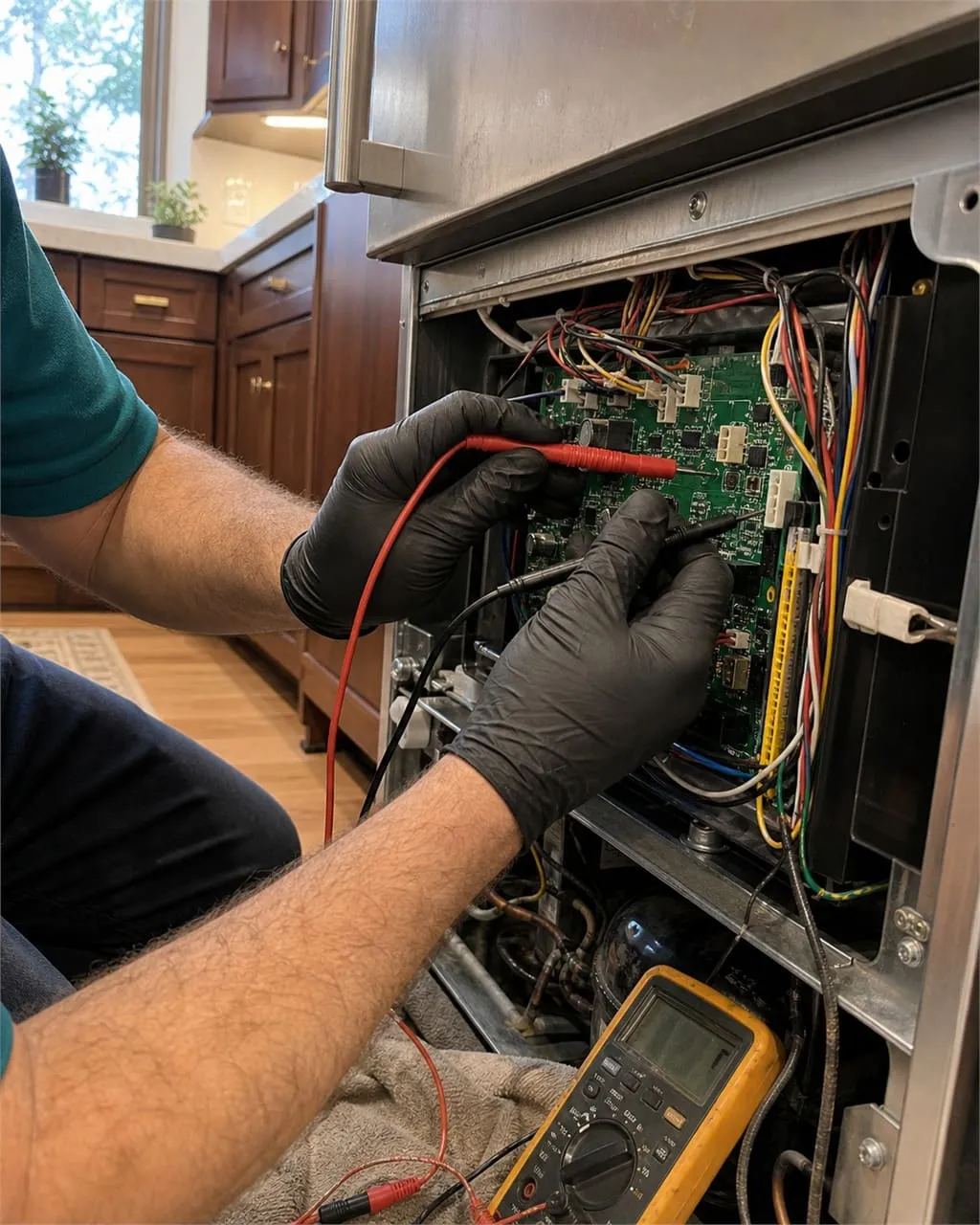
“My Sub-Zero stopped working” — start with the symptom
A Sub-Zero rarely fails all at once. Far more often one system stops behaving while the rest of the cabinet works fine — the fridge warms but the freezer stays cold, the ice maker quits while the box still chills, or the unit runs loud yet holds temperature. Because built-ins use dual refrigeration and several independent subsystems, the symptom you are seeing usually points straight at the part that failed. That is the fastest way to triage a broken Sub-Zero before anyone touches it.
This page is a hub for Campbell homeowners who are not yet sure what is wrong. Below, each fault mode — won’t cool, won’t make ice, won’t turn on, error or service light, sealed-system signs, leaking, and loud — links out to the focused guide that walks through the checks and the fix. Match what your unit is doing, follow the link, and you will know whether it is a quick part swap or something that needs a specialist’s eyes.
We are a Campbell-based, Sub-Zero-only shop covering Downtown Campbell, San Tomas, the Pruneyard area and the Cambrian-adjacent streets. If the symptom points to food at risk, jump to emergency repair; otherwise read on and pick your fault below.
What is your Sub-Zero doing? Pick the symptom
Each fault mode below links to the focused Campbell guide that covers the causes and the fix. Match the closest match to what your built-in is doing.
Won’t cool / running warm
Fridge or freezer climbing out of temperature while the other side stays fine. Usually an evaporator fan, frost-blocked coil or sensor — full walkthrough on Sub-Zero not cooling.
Won’t make ice
No cubes, slow ice or a leaking ice maker. Frozen fill tube, failed inlet valve, worn module or optical sensor — diagnosis on ice maker not working.
Won’t turn on / completely dead
No lights, no compressor, no fans. Power supply, a tripped protector or a control fault. A dead box means everything inside is warming — treat it as urgent.
Error / service light lit
A wrench or service icon flagging a sensor, an overdue condenser, or a system error. Decode it before you clear it on service light meanings.
Sealed-system signs
Runs constantly but never gets cold, or one side fails after a frost build-up. Compressor, evaporator or refrigerant-circuit faults need factory-spec diagnosis — see repair cost for ranges.
Leaking water
Water inside or pooling on the floor. Blocked drain, split ice-maker fill tube or a failed inlet valve. Shut the water supply off if it is active, then book a diagnosis.
Sub-Zero fault finder — symptom, likely cause, next step
A broken Sub-Zero almost always narrows to one system. Match your symptom, read the likely cause, then jump to the focused guide.
| What it is doing | Most likely cause | Where to go next |
|---|---|---|
| Fridge warm, freezer cold (or reverse) | Failed evaporator fan, frost-blocked coil or dual-refrigeration sensor | See not cooling |
| No ice or slow ice | Frozen fill tube, failed inlet valve, worn module or optical sensor | See ice maker not working |
| No lights, totally dead | Power supply, tripped protector or main control fault | Check breaker once, then urgent repair |
| Service / wrench light lit | Sensor fault, condenser overdue, or control flagging an error | Decode on service light |
| Runs constantly, never cold | Sealed-system fault, failed fan, or heavy frost on the coil | Sealed-system diagnosis — see cost guide |
| Water inside or on the floor | Blocked drain, split fill tube or failed inlet valve | Shut water off; book a leak diagnosis |
| Loud, buzzing or rattling | Caked condenser, failing condenser/evaporator fan, or loose component | Vacuum condenser; if noise persists, book a check |
| Wine unit drifting warm | Thermoelectric module, condenser fan, or dual-zone control fault | See wine cooler repair |
A frost-blocked coil or failed fan can mimic a dead compressor — factory-spec diagnosis before parts is what keeps a broken-Sub-Zero repair from being paid for twice.
Three quick checks before you book
A few safe checks at home can tell you whether it is a five-minute fix or a real fault — and they make our phone triage sharper.
- Confirm it has power
For a dead unit, check the breaker and that the plug or hardwire is live. A tripped breaker or bumped plug is the cheapest fix there is — but reset only once, never repeatedly.
- Look for frost and airflow blocks
Open the box and check for heavy frost on the rear interior wall or vents packed with food. Blocked airflow can mimic a cooling failure on an otherwise healthy unit.
- Check the condenser
Behind the upper grille, a condenser caked in dust makes a Sub-Zero run loud and warm. Vacuuming it is safe DIY and sometimes resolves noise and weak cooling on its own.
- Read the service light
Note any wrench or service icon and how it is flashing before clearing it. The pattern is a clue — write it down so we can decode the fault on the phone.
When a “broken” Sub-Zero is really a small fault
Plenty of calls that start with “my Sub-Zero is broken” end with a part that costs a fraction of a replacement. A built-in cabinet and sealed system are engineered to last decades, so when one fails it is usually a consumable around it — a fan, a sensor, a gasket, an inlet valve, an ice-maker module — rather than the compressor itself. Reading the symptom correctly is what separates a $300 fix from a needlessly quoted board or sealed-system job.
That is exactly where a Sub-Zero-only shop earns its keep. Our technicians see your Classic BI, integrated column, designer built-in or wine unit every week, so we recognize the difference between a frost-blocked coil and a dead compressor, or a failing sensor and a bad board. We chase the real fault and fit genuine OEM Sub-Zero parts so the unit behaves the way it was engineered to.
If your symptom points to a true sealed-system failure, we will tell you honestly and quote it after pressure and electrical evidence — never on a guess. Either way, every repair carries a 365-day labor warranty, and the $89 service call is waived when you book the work.

A $89 service call, waived when you book the repair, plus a phone symptom check before we drive out so you are never paying twice to find the fault. Genuine OEM Sub-Zero parts, a 365-day labor warranty, and a Sub-Zero-only technician who already knows your series.
Quick answers
Sub-Zero not working in Campbell: straight answers
The questions Campbell homeowners ask when a built-in stops behaving.
My Sub-Zero stopped working — is it the compressor?
Usually not. A built-in compressor and sealed system are built to last decades, so a unit that “stops working” is far more often a failed fan, sensor, control or ice-maker part. A frost-blocked coil or dead fan can mimic a dead compressor, which is why we diagnose the symptom before quoting any sealed-system work. See not cooling to narrow it down.
Why is my Sub-Zero warm on one side but cold on the other?
Built-in Sub-Zeros use dual refrigeration, so the fridge and freezer run on separate systems. One warm side usually points to a failed evaporator fan, a frost-blocked coil or a sensor on that circuit — not the whole unit. Our not-cooling guide walks through the checks before you book.
My Sub-Zero won’t turn on at all — what now?
Check the breaker and that the plug or hardwire is live, and reset a tripped breaker once. If it stays completely dead — no lights, no fans, no compressor — it is likely a power, protector or control fault, and everything inside is warming, so treat it as urgent and call.
There is a light or icon on — is the unit broken?
A wrench or service icon flags a fault the control has detected — a sensor, an overdue condenser, or a system error. It does not always mean a major failure, but you should decode the pattern before clearing it. Our service light meanings page explains what each indication points to.
Is it worth repairing or should I replace it?
Repair is usually the better value. Built-in replacement runs well into five figures, while most faults are a fan, gasket, sensor, valve or board for a fraction of that. We will tell you honestly when a unit has genuinely reached the end — but on a sound Classic BI or column, that is the exception. See the cost guide for ranges.
A Sub-Zero specialist for every fault, across Campbell
Whatever your symptom points to, it reaches a technician who works only on Sub-Zero built-ins — Classic BI 600/700, integrated columns, designer units, wine storage and ice makers. That focus is why we can read a dual-refrigeration box, a defrost fault or a sealed system quickly instead of working it out on your kitchen floor. The narrower the shop, the faster the right diagnosis.
We cover all of Campbell — Downtown Campbell, San Tomas, the Pruneyard area and the Cambrian-adjacent streets toward Los Gatos Creek Trail — with local dispatch inside Santa Clara County. If a warm box has groceries on the clock, go straight to emergency repair or ask about a same-day slot.
Still not sure which fault you have? Call and describe what the unit is doing. A phone symptom check costs nothing and is the fastest way to turn a “broken Sub-Zero” into a stocked, targeted visit — local, OEM parts, 365-day labor warranty.
Reviews
Campbell Sub-Zero diagnoses, in their words
Independent Sub-Zero repair · Campbell & the Santa Clara Valley
I had no idea why our Sub-Zero quit — it was running but the fridge side kept warming. Their fault-finder helped me describe it on the phone, they recognized it as an evaporator fan right away, and fixed it the same week with an OEM part. So much better than the generic repair guy who wanted to replace the board.
Unit went totally dead and I assumed the worst. They had me check the breaker first — which I would never have thought of — and when it was still dead they came out and found a control fault, not a compressor. Honest, knew the Classic BI inside out, and the $89 call was waived with the repair.
Service light was on and the ice maker had stopped. I expected two problems but it turned out to be one sensor flagging both. They explained exactly what the light meant before clearing it and used a genuine part. Clear, calm and they obviously do only Sub-Zero — it showed.
Loud rattling and weak cooling. They walked me through vacuuming the condenser, which helped the noise, then came out and found a failing condenser fan. One short return trip for the part but a fair diagnosis and a 365-day warranty on the labor. Would use again.
FAQ
Sub-Zero not working FAQ — Campbell
My Sub-Zero stopped working — what is the most likely problem?
It depends on the symptom, but a unit that “stops working” is most often a failed evaporator fan, a frost-blocked coil, a sensor, a control fault or an ice-maker part — not the compressor. Built-in sealed systems are engineered to last decades. Match what your unit is doing to our fault finder above, then follow the link to the focused guide for that symptom.
Why is my Sub-Zero not cooling but still running?
A built-in that runs but will not get cold usually has a failed evaporator fan, a frost-blocked coil restricting airflow, or a defrost fault — and on dual-refrigeration models, often only one side is affected. Heavy frost or a caked condenser can also choke cooling. Our Sub-Zero not cooling page walks through the checks before you book a diagnosis.
My Sub-Zero won’t turn on — is it the control board?
Not necessarily. First confirm the breaker is on and the plug or hardwire is live, and reset a tripped breaker once. If it stays completely dead, the cause is usually a power supply issue, a tripped protector or a main control fault — and the diagnosis tells them apart. Because everything inside warms while it is off, treat a dead unit as urgent and call.
What does the service or wrench light on my Sub-Zero mean?
It means the control has detected a fault — commonly a temperature sensor, an overdue condenser cleaning, or a system error. The flash pattern is a clue to which one. Note it before clearing the light, and check our service light meanings guide. If the light is paired with a warming box, treat it as an active fault and call rather than just resetting it.
My Sub-Zero is leaking water — where is it coming from?
The usual sources are a blocked defrost drain, a split or kinked ice-maker fill tube, or a failed water inlet valve. If water is actively pooling, shut off the dedicated water supply valve behind or beneath the unit and wipe standing water away from cabinetry. Then book a diagnosis so the leak is traced to its real source rather than patched.
Is it worth repairing a broken Sub-Zero or should I replace it?
Repair is almost always the better value. A built-in cabinet and sealed system are built to last decades, while replacement runs well into five figures. Most faults are a fan, gasket, sensor, valve or board for a fraction of that cost. We will tell you honestly when a unit has truly reached the end, but on a sound Classic BI or column that is the exception, not the rule.
Keep going
Jump to the right Sub-Zero guide
Sub-Zero acting broken in your Campbell kitchen?
Tell us the symptom and we will point you to the fix — or just book a specialist. $89 service call waived with your repair, 365-day labor warranty, OEM parts.
$89 service call, waived when you book the repair. 365-day warranty on all labor. We install genuine OEM Sub-Zero parts.
596 reviews · 4.9 / 5